The loading frame sits in the middle of our Oxford lab, a steady rhythm of the proving ring pressing a 50 mm plunger into a compacted soil sample at 1.27 mm per minute. Over the years we have run hundreds of these California Bearing Ratio tests on materials pulled from across the county — from the limestone brash of the Cotswold fringe to the alluvial silts near the Thames floodplain. What makes the laboratory CBR test so valuable for Oxford projects is its direct link to pavement thickness design, especially where local highway authorities demand BS 5930 and the Design Manual for Roads and Bridges (DMRB) methods. Unlike a rushed field index test, the controlled environment of the lab lets us dial in moisture content, density, and saturation conditions to mirror what that subgrade will actually see come January. For deeper site characterisation before sampling, we often cross-reference results with CPT test data to correlate in-situ behaviour with remoulded laboratory strength.
A soaked CBR value below 2 % isn't a roadblock — it's a design parameter that tells you exactly what kind of capping layer and stabilisation you'll need.
Methodology applied in Oxford
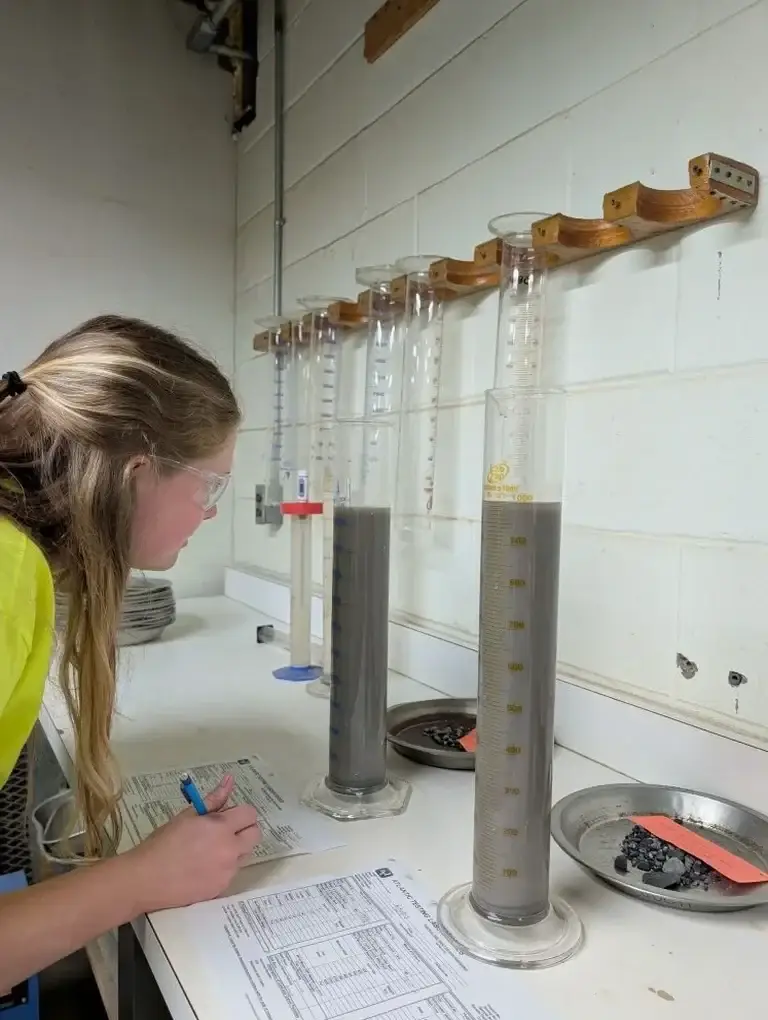
Local geotechnical conditions in Oxford
Oxford's development pattern — medieval core, Victorian suburbs, modern edge-of-city expansions — means we encounter wildly different subgrade histories within a single project. The 20th-century housing estates around Blackbird Leys and Barton often sit on made ground with brick rubble and ash fill, while the science park expansions near the A34 cut into weathered Oxford Clay. The laboratory CBR test becomes essential in these transitions because a visual classification alone won't tell you how that fill will behave when saturated. We have seen situations where two boreholes 30 metres apart produced CBR values of 1 % and 8 % — same map unit, completely different compaction history. The risk of assuming uniformity is pavement failure within two to three years, especially on bus routes and access roads where heavy vehicles concentrate loading. The soaked laboratory CBR test, run properly with site-specific moisture conditioning, gives the design team a defensible basis for capping layer thickness and keeps the long-term maintenance liability manageable.
Our services
Our Oxford laboratory runs the full cycle of CBR testing alongside complementary soil characterisation, so you get a complete picture of subgrade performance without splitting samples across multiple labs.
Soaked and Unsoaked Laboratory CBR
Full BS 1377-4 procedure with 96-hour soaking under calibrated surcharge rings, swell measurement, and load-penetration curves for both 2.5 mm and 5.0 mm plunger travel. We report the corrected CBR value and flag any anomalies in the curve shape that might indicate poor compaction or sample disturbance.
CBR with Moisture-Density Relationship
We run the compaction test first — either 2.5 kg or 4.5 kg rammer method depending on the material — to establish the OMC and maximum dry density, then compact the CBR moulds at the target moisture range. This pairing is what Oxfordshire County Council typically requires for Section 278 agreements and adoption submissions.
Quick answers
How much does a laboratory CBR test cost in Oxford?
A single-point laboratory CBR test, including the compaction curve and 96-hour soak, typically runs between £100 and £170 depending on whether you need one or three moulds. A full three-point CBR family — which gives the moisture-density-CBR relationship across wet, optimum, and dry conditions — sits at the upper end of that range and is what we recommend for road design submissions to Oxfordshire County Council.
What is the difference between soaked and unsoaked CBR, and which one matters for pavement design?
The unsoaked CBR tells you the strength of the subgrade at the moisture content it had when it left the site. The soaked CBR — after four days submerged with surcharge weights — simulates the worst-case saturated condition that the subgrade will reach over the pavement's life. For design, the soaked value is the one that governs. In Oxford's clay-rich formations, the drop between the two can be dramatic, and basing your capping layer thickness on the unsoaked figure is a risk no highway engineer should take.
How should we sample and transport soil for a CBR test from an Oxford site?
Bring us at least 25 kg of representative disturbed material in sealed heavy-duty bags — double-bagged if the soil is wet, because dried-out samples won't compact properly in the lab. Label each bag with the chainage, depth, and material description. If you are sampling from a trial pit, take the material from the formation level, not the spoil heap. We can arrange collection across Oxford and the surrounding Thames Valley if that helps keep your site team focused on the dig.