Many foundation designs in Oxford fail because the ground model relies on sparse borehole data alone. A single SPT can miss thin soft layers, lenses of peat, or variable gravel pockets typical of the Thames river terrace deposits. The result is either an over-designed foundation that bleeds budget or a shallow footing that settles differentially within a few years. The CPT test avoids this by giving a near-continuous profile of tip resistance and sleeve friction. Each centimetre is logged. The data feeds directly into bearing capacity calculations under Eurocode 7. Combined with triaxial testing on targeted samples, the cone penetration test becomes the backbone of a defensible ground investigation report.
A single CPT trace from the Oxford Clay reveals more about stratification than three SPTs spaced five metres apart.
Methodology applied in Oxford
Local geotechnical conditions in Oxford
Oxford's medieval core expanded onto the floodplain during the 19th century. Many Victorian-era buildings sit on shallow brick footings over made ground containing rubble, ash, and organic debris. This artificial layer is highly variable. A cone penetration test quickly identifies its base by a marked increase in tip resistance when entering natural gravel or clay. Overlooking this transition depth has caused differential settlement in several Jericho and Osney Island structures. A second problem is dissolution features in the underlying limestone, where sudden loss of cone resistance signals a potential void or softened zone. Our team cross-checks these anomalies with the seismic refraction method to confirm whether the feature is isolated or part of a larger karst network. The BS 5930 code of practice specifically recommends direct investigation methods like CPT when the desk study indicates possible dissolution hazards.
Our services
Our Oxford cone penetration testing service includes everything from rig mobilisation to a final interpretive report. Each project follows the specification laid out in BS EN 1997-2.
Piezocone (CPTU) Profiling
Measures qc, fs, and u2 simultaneously. Essential for distinguishing drained gravel from undrained clay behaviour in Oxford's river terrace deposits.
Dissipation Tests
Stops the cone at target depths to record pore pressure decay. Used to estimate the coefficient of consolidation in Oxford Clay for settlement rate predictions.
Friction Ratio Soil Classification
Real-time plotting of Rf against qc to identify soil behaviour type. Helps separate the Summertown-Radley gravel from the clay matrix without sampling.
CPT-Seismic (SCPTU) Add-on
Integrates a geophone module to measure shear wave velocity downhole. Provides small-strain stiffness for dynamic analysis of structures near the A34 or railway corridors.
Quick answers
What depth can a CPT rig reach in Oxford's geology?
In the dense Summertown-Radley gravel, refusal is common between 10 and 15 metres. In the Oxford Clay, we routinely push to 25 metres. The actual refusal depth depends on gravel thickness and particle angularity. We recommend a pre-survey review of BGS borehole records to estimate pushability.
Can CPT testing be done inside existing buildings in Oxford?
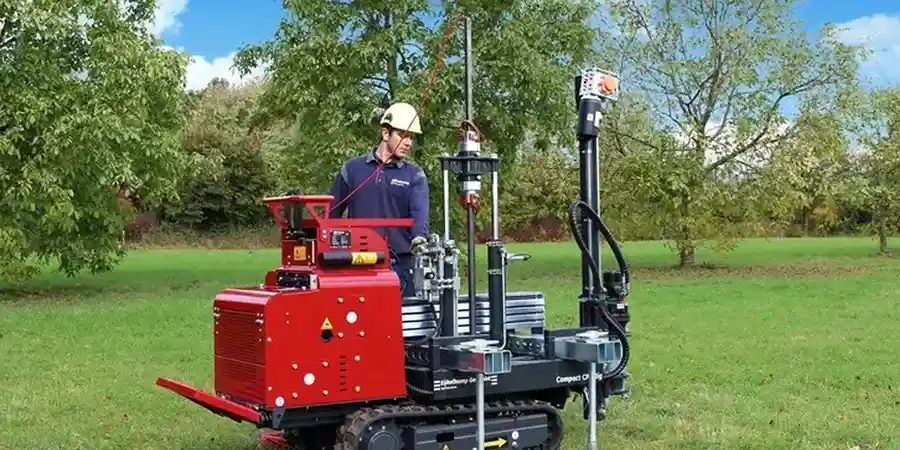
Yes, provided there is a minimum headroom of 2.8 metres. We use a crawler-mounted mini-rig that fits through standard double doors. The thrust is anchored against the floor slab or a ballast frame. We have tested inside several listed college buildings where open ground was limited to a basement or courtyard.
How much does a CPT test cost in Oxford?
A single CPT profile in Oxford typically ranges from £110 to £220 per metre pushed, depending on depth, site access, and whether piezocone or seismic modules are required. A full day of testing with multiple locations starts around £1,200, including mobilisation within the ring road.
What is the difference between CPT and standard SPT boreholes?
An SPT recovers a disturbed sample every 1.5 metres and gives an N-value. A CPT provides continuous cone resistance, sleeve friction, and pore pressure every 10 millimetres without sampling. The result is a high-resolution stratigraphic profile. In Oxford's interbedded gravels and clays, CPT detects thin layers that SPT intervals can easily miss, leading to a more reliable ground model for foundation design.