Oxford's geological setting presents a distinct challenge for construction: the River Thames and River Cherwell carve through the city, leaving behind extensive Quaternary alluvium — loose sands, soft silts, and gravels — that blanket the underlying Oxford Clay. This floodplain geology, combined with a high water table that often sits just a metre below ground level in areas like Osney Island and Jericho, means that conventional shallow foundations frequently encounter insufficient bearing capacity. Loose granular deposits are particularly susceptible to settlement under load, and in a city where historic college buildings stand alongside modern research facilities, differential movement is simply unacceptable. Our vibrocompaction design service addresses this directly. By deploying depth vibrators to densify loose sands and gravels in-situ, we improve soil stiffness and eliminate the collapse potential of poorly compacted fill. The technique is well-suited to Oxford's river terrace deposits, where granular layers between 2 and 15 metres depth can be treated without excavation, preserving the site and accelerating programme delivery. For sites where the alluvium transitions into softer cohesive layers, we often recommend complementary investigation with CPT testing to map the stratigraphy continuously before specifying the compaction grid.
Loose Thames Valley gravels can drop over 100 mm of settlement under foundation load if left untreated — vibrocompaction design eliminates that risk before a single brick is laid.
Methodology applied in Oxford
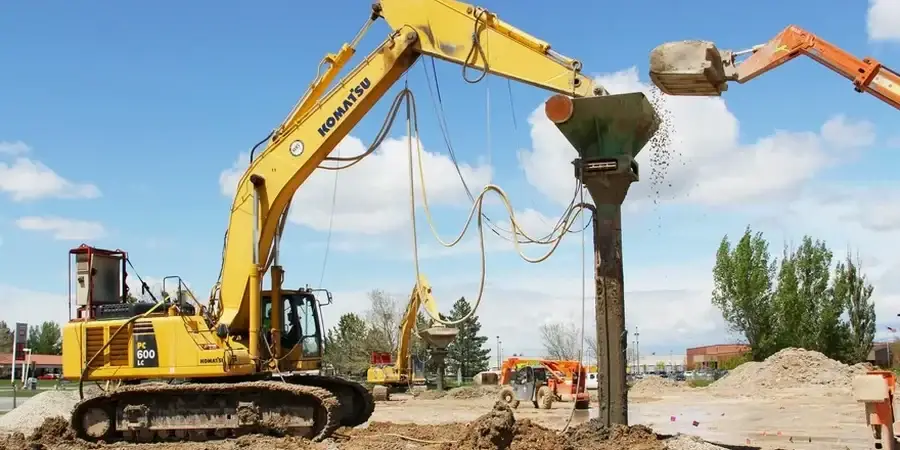
Key design parameters we specify include: vibrator power class (typically 130–180 kW for Oxford's gravels), water or air flush requirements, and settlement tolerance post-treatment, usually targeting a relative density above 70 percent. The design also addresses environmental constraints — vibration monitoring thresholds near listed structures, noise limits in residential zones, and water management in areas with elevated groundwater. Oxford's dense urban fabric, with its narrow access lanes and heritage-sensitive buildings, means that every vibrocompaction design must balance technical performance with practical site logistics.
Local geotechnical conditions in Oxford
A six-storey residential development near the Cowley Road encountered a layer of loose, water-bearing sand at 4 metres depth during initial site investigation. The original foundation design proposed bored piles socketed into the Oxford Clay, but the presence of the loose sand posed a risk of pile necking during drilling and excessive settlement under the pile cap. The contractor considered proceeding without ground treatment, relying on deeper pile sockets to bypass the problem layer. That decision would have increased pile lengths by over 30 percent and added significant cost and programme delay. Instead, our vibrocompaction design specified a pre-treatment phase that densified the sand layer across the entire building footprint in just four working days. Post-treatment CPT testing confirmed a cone resistance increase from 4 MPa to over 12 MPa, eliminating the pile necking risk and allowing the original pile design to proceed unchanged. Skipping this step in Oxford's alluvial environment can turn a manageable ground risk into a structural defect — settlement cracks, misaligned works, and costly remedial underpinning.
Our services
Our vibrocompaction design service covers the full project lifecycle, from feasibility assessment through to post-treatment verification. Each design is tailored to the specific ground conditions encountered on site and the performance requirements of the structure above.
Feasibility assessment and treatability study
Review of existing ground investigation data to determine whether vibrocompaction is technically suitable. Includes grain size analysis, fines content assessment, and preliminary grid sizing.
Detailed vibrocompaction design package
Production of design drawings showing probe layout, treatment depths, and compaction sequence. Includes specification of vibrator parameters, water/air flush requirements, and environmental monitoring thresholds.
Post-treatment verification and compliance report
Execution and interpretation of before-and-after CPT or SPT testing to validate compaction effectiveness. Final report documents achieved relative density and confirms compliance with design acceptance criteria.
Quick answers
How much does a vibrocompaction design cost for a typical Oxford site?
For most projects in Oxford, the vibrocompaction design fee ranges from £1.150 to £3.800, depending on the site area, treatment depth, and the extent of existing ground investigation data available. A smaller residential plot with good-quality borehole logs will fall at the lower end, while a larger commercial development requiring supplementary CPT testing and detailed vibration assessment will be closer to the upper end. The design cost typically represents less than 5 percent of the total ground improvement works budget.
What soil conditions make vibrocompaction unsuitable?
Vibrocompaction is most effective in granular soils — sands and gravels — with a fines content below 15 percent. When the silt and clay fraction exceeds this threshold, the vibrator cannot effectively rearrange the soil particles, and alternative techniques such as stone columns become more appropriate. Sites with very shallow groundwater, thick organic layers, or contamination that could be mobilised by vibration also require careful assessment during the feasibility stage.
How long does the design process take from instruction to issue?
A typical vibrocompaction design package for an Oxford project is completed within 10 to 15 working days from receipt of the ground investigation data. Where supplementary CPT testing is required to fill data gaps, the programme extends by the fieldwork and laboratory turnaround time — usually adding two to three weeks. We always coordinate testing schedules with the main contractor to avoid delaying the overall project programme.
What verification is required after vibrocompaction is completed?
BS EN 14731:2005 requires post-treatment verification to confirm that the specified relative density or cone resistance has been achieved. On Oxford sites, we typically specify CPT testing at the centroid of the compaction grid, with a minimum of one test per 300 square metres of treated area. Results are compared directly with pre-treatment CPT data from the same locations. Acceptance criteria are defined in the design package — usually a minimum cone resistance of 10–12 MPa for river terrace gravels — and a compliance report is issued for building control approval.