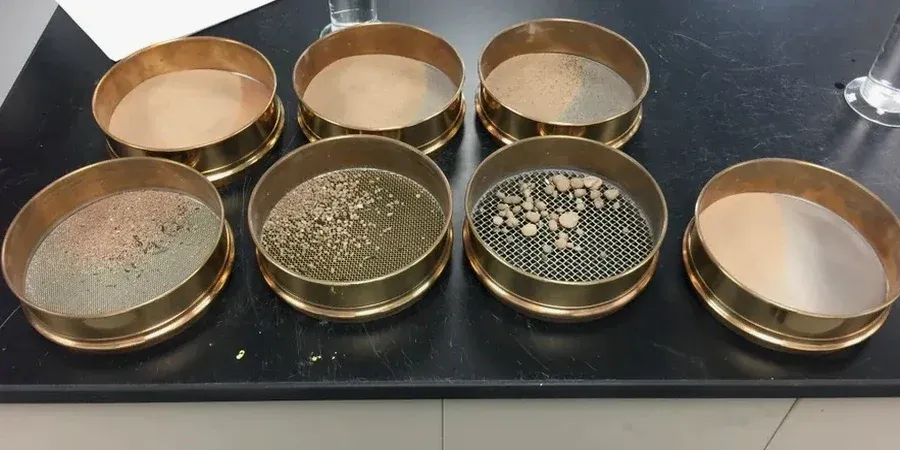
The Thames floodplain gravels and Oxford Clay define the city's foundation conditions. A site off Abingdon Road recently revealed a 3-metre alluvium lens beneath a thin gravel cap, missed entirely by borehole logs. That single stratum changed the dewatering design overnight. Particle size distribution isn't a formality here. It's the difference between a drained excavation and a flooded one. Our lab runs the full sieve and hydrometer procedure to BS 1377-2:1990, quantifying everything from coarse gravel to sub-2-micron clay. When Oxford's river terrace deposits mix with windblown brickearth, only the combined method captures the real grading curve. The hydrometer step reads silt-clay fractions that sieves alone cannot resolve, critical for frost susceptibility classification under BS EN ISO 17892-4:2016.
A grading curve without the hydrometer fraction misses 40% of Oxford's typical alluvial profile. That's the difference between a drained design and a flooded basement.
Methodology applied in Oxford
Local geotechnical conditions in Oxford
A basement excavation in Jericho hit running sand at 4 metres. The contractor had a grading curve from a sieve-only test showing 95% sand. What that report didn't show was the 5% silt fraction, enough to make the material internally unstable when groundwater flowed. The combined method would have flagged the gap-graded nature and triggered a filter design review before dewatering started. Oxford's Summertown and Wolvercote areas sit on river terrace deposits where clean gravel lenses alternate with silty fine sand. A single point on a grading curve can dictate whether a wellpoint system works or collapses. Skip the full analysis and you're designing blind for groundwater control, concrete mix design, and frost heave susceptibility. The Eurocode 7 framework requires characteristic values derived from a proper particle size distribution, not an assumption.
Our services
Our Oxford laboratory delivers the full combined analysis with a three-working-day turnaround standard. Expedited service processes samples in 24 hours when site programmes demand it. Each report includes the semi-log grading curve, calculated uniformity and curvature coefficients, and soil classification to BS 5930.
Combined Sieve and Hydrometer Analysis
Full particle size distribution from 75 mm down to sub-2-micron clay fraction. Two-stage testing with mechanical sieving and sedimentation hydrometer. Includes D10, D30, D60, Cu, and Cc calculation. Suitable for all Oxford alluvial and residual soils.
Single-Point Hydrometer (Clay Fraction Only)
Targeted sedimentation test for fine-grained Oxford Clay and brickearth samples. Quantifies clay content for plasticity correlation and frost susceptibility assessment. Useful when coarse fraction is minimal and full sieving is unnecessary.
Grading Curve Interpretation Report
Engineering assessment of the particle size distribution with filter design compatibility checks, permeability estimation via Hazen and Kozeny-Carman methods, and frost heave classification per BS 812 and PD 6682 guidance. Delivered alongside raw lab data.
Quick answers
How much does a combined sieve and hydrometer test cost in Oxford?
Standard combined analysis for one sample ranges between £80 and £140, depending on the number of sieve sizes requested and whether expedited turnaround is needed. Volume pricing applies for projects with five or more samples.
What is the difference between a sieve-only and a combined analysis?
Sieve analysis stops at 63 microns and reports everything finer as a single 'fines' percentage. The combined method continues with a hydrometer sedimentation test that quantifies silt and clay fractions separately. Oxford's alluvial soils routinely contain 15-40% silt-clay content that sieves cannot differentiate, but which controls permeability and frost behaviour.
How long does the laboratory testing take?
Standard turnaround is three working days from sample receipt. The hydrometer phase requires a 24-hour sedimentation period to capture the full clay fraction. We offer a 24-hour expedited service for time-sensitive Oxford construction programmes, though the finest clay reading may have slightly reduced precision.
What sample size do you need for the combined test?
For predominantly granular Oxford gravels and sands, we need approximately 5 kg of material. For fine-grained Oxford Clay samples, 500 grams is sufficient. Samples must be delivered in sealed, labelled bags with chain-of-custody documentation. We can arrange courier collection from your Oxford site if required.