Applying BS EN 1997-1:2004 (Eurocode 7) and BS 5930:2015 is not a generic exercise in Oxford. The city sits on a patchwork of lithologies that shift from dense, high-plasticity Oxford Clay in the east to the Quaternary river terrace gravels and alluvium along the Thames and Cherwell valleys. When a deep excavation is planned near the Westgate Centre or a retaining wall must be installed within the historic university precinct, the ground anchor design must account for sudden changes in shear strength over very short distances. Our laboratory team routinely prepares the site-specific ground investigation data required for these analyses, ensuring the triaxial testing results that define the bond zone parameters are solid. This data-driven approach allows us to model active and passive earth pressures with the precision that Oxford's complex geology demands, avoiding the over-conservative assumptions that inflate project costs.
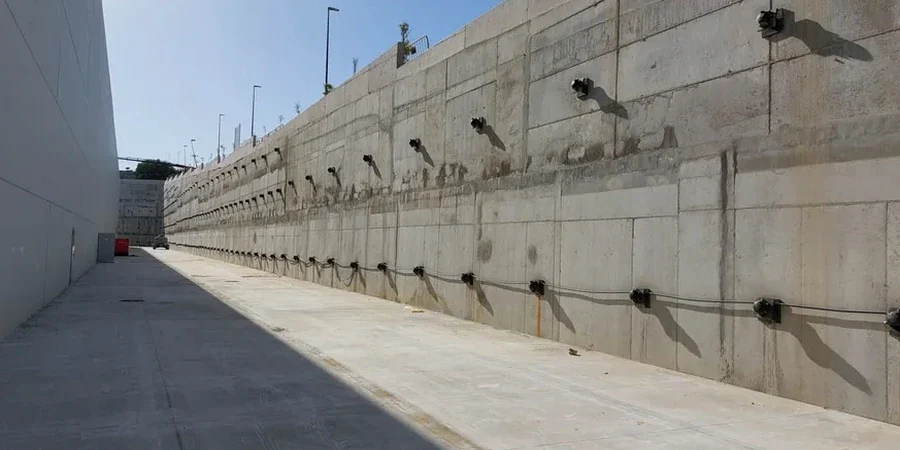
A well-designed ground anchor in Oxford transfers tension beyond the potential slip circle, turning the variable near-surface geology into a predictable structural element.
Methodology applied in Oxford
Local geotechnical conditions in Oxford
The geotechnical contrast between the Summertown and Jericho areas illustrates the critical risk. In Jericho, close to the canal, the ground comprises loose floodplain alluvium with a high water table, often requiring a dense array of prestressed active anchors to limit lateral movement of sheet pile walls. Less than two kilometres northeast in Summertown, the competent Oxford Clay permits a more economical passive anchoring strategy for basement excavations, relying on the soil's own strength to stabilise the cut. The greatest hazard arises when the anchor bond zone is placed incorrectly within the laminated, fissured zone of the clay, where strength anisotropy can lead to a progressive creep failure that design calculations based on isotropic strength parameters fail to capture. Ignoring the local hydrogeological regime—specifically the perched water tables within the gravel lenses—can also lead to a sudden loss of confinement during drilling, destabilising the nearby pavement and existing foundations.
Our services
Our anchor design methodology is based on a closed loop between site investigation, laboratory testing, and detailed numerical analysis. We define the anchor working loads directly from the soil parameters measured in our Oxford-based laboratory.
Active Anchor System Design
Complete design package for prestressed strand anchors, including free length determination using Kranz's force method, fixed length sizing based on BS 8081 bond capacity, and specification of a double-corrosion-protection system for permanent applications in the chemically aggressive Oxford Clay groundwater.
Passive Anchor and Soil Nail Analysis
Design of unreinforced and reinforced passive anchors for top-down construction in Oxford's overconsolidated clays. We use the characteristic pull-out resistance from site-specific testing to define the nail density pattern and verify the global stability with limit equilibrium methods incorporating the staged excavation sequence.
Quick answers
What is the typical cost for designing a permanent active anchor system for a retaining wall in Oxford?
For a design package covering a single retaining wall with a permanent prestressed anchor system, the fee typically falls between £780 and £2,950. The final cost depends on the number of anchor levels, the complexity of the ground profile (such as the variable gravel beds along the Cherwell), and the requirement for field testing specifications.
How does a prestressed active anchor differ from a passive soil nail in practice?
An active anchor is tensioned after installation to apply a known load to the structure, immediately restraining movement—a necessity when retaining sensitive historic buildings in central Oxford. A passive anchor, such as a soil nail, is not tensioned; it develops its resistance only as the ground deforms, making it suitable for slope stabilisation in new-cut excavations where controlled movement is acceptable.
What laboratory tests are needed to determine the bond zone capacity in Oxford Clay?
A solid design requires the undrained shear strength profile from consolidated undrained triaxial compression tests, along with index testing for plasticity and liquidity indices. For permanent anchors, we also recommend chemical analysis of the groundwater to classify the aggressivity of the environment, which dictates the level of corrosion protection as per BS 8081. More info.