Oxford sits at just 68 metres above sea level on a floodplain carved by the Thames and Cherwell, where the alluvial clays and river terrace deposits vary dramatically over short distances. Construction projects across the city, from Jericho’s Victorian terraces to Headington’s newer developments, routinely encounter high-plasticity clays that require precise classification before any geotechnical design can begin. Atterberg limits testing under BS 5930 provides the quantitative boundaries between solid, semi-solid, plastic, and liquid states – a fundamental step that directly influences bearing capacity calculations, earthworks specifications, and retaining wall design. The Oxford Clay Formation underlies much of the area and has been the subject of extensive geotechnical research since the 19th century, making the city a place where soil behaviour is well understood but still demands site-specific verification. When working on the Gault Clay outcrops near Cowley or the alluvial silts near Osney Mead, the laboratory-derived Atterberg limits become the reference against which all subsequent slope stability analyses and footing designs are calibrated.
A plasticity index above 25% in Oxford Clay signals high shrinkage-swell potential – a parameter that directly governs foundation depth and reinforcement requirements in this region.
Methodology applied in Oxford
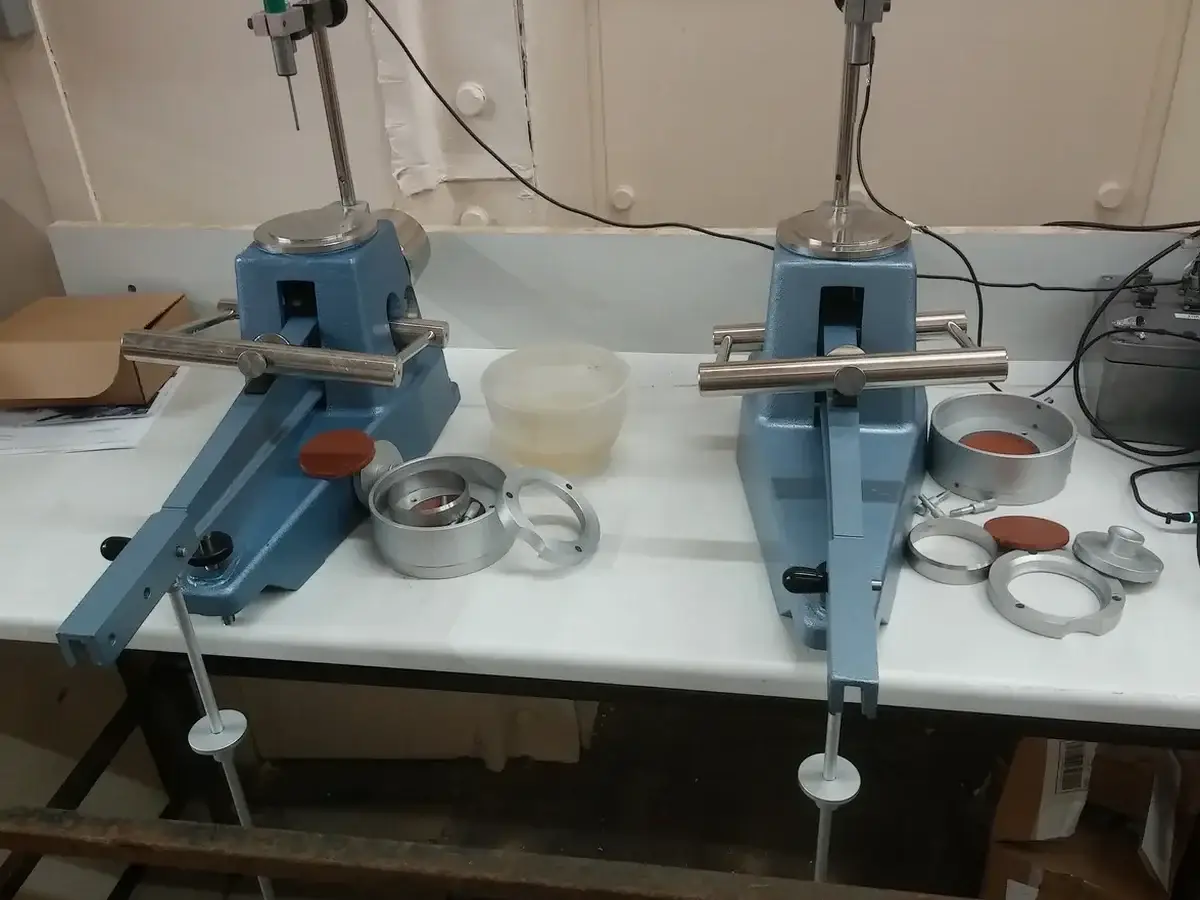
Local geotechnical conditions in Oxford
In Oxford Clay terrain, we frequently see contractors who assume a stiff consistency based on surface observations, only to encounter softened, fissured material at depth that behaves as a plastic silt. The liquidity index tells the real story: a value near or above 1.0 indicates the soil will deform plastically under load even if it appears competent when first exposed. This misclassification risk is particularly acute in the Thames floodplain alluvium where seasonal groundwater fluctuations alter the in-situ moisture content significantly. Specifying foundation types without Atterberg limits is a gamble – the difference between a PI of 12% and one of 35% changes the predicted swell pressure by an order of magnitude. BS EN 1997-2 explicitly requires plasticity testing for fine soils as part of the ground investigation report, and the Oxford City Council building control process will flag submissions that lack this data. The cost of retrofitting underpinning or dealing with differential settlement after construction far exceeds the investment in a properly executed Atterberg limits test programme.
Our services
Our Oxford laboratory provides Atterberg limits testing as part of a complete geotechnical characterisation package. Each test programme is designed around the specific geology encountered on site.
Oxford Clay Plasticity Profiling
Depth-specific Atterberg limits testing across the Oxford Clay Formation to map consistency changes and identify weathered zones that affect foundation performance.
Shrinkage-Swell Assessment
Combined plasticity index determination and volumetric shrinkage testing to quantify the risk of ground movement in areas underlain by the Gault Clay and alluvial deposits.
Earthworks Quality Control
Routine plastic limit testing to verify that fill materials meet the compaction water content specifications set out in the project's earthworks design.
Site Investigation Support
Full classification testing including Atterberg limits, particle size distribution, and moisture content on samples recovered from trial pits and boreholes across Oxfordshire.
Quick answers
What do Atterberg limits actually tell me about my Oxford site?
Atterberg limits define the moisture content boundaries between different soil consistency states – liquid, plastic, semi-solid, and solid. The liquid limit and plastic limit, together with the plasticity index, allow you to classify fine-grained soils according to BS 5930 and the Unified Soil Classification System. For an Oxford site on Oxford Clay, a high plasticity index (above 25-30%) indicates a soil with significant volume change potential when moisture fluctuates, which directly impacts foundation depth, reinforcement requirements, and long-term settlement predictions.
How much does Atterberg limits testing cost in Oxford?
Atterberg limits testing in Oxford typically ranges from £50 to £70 per sample, depending on whether you need just the liquid and plastic limits or the full suite including moisture content, linear shrinkage, and density. The total project cost depends on the number of samples recovered from your site investigation – a standard residential borehole programme might generate 6 to 12 testable samples from the clay horizons. We deliver a detailed quotation after reviewing the exploratory hole logs.
How long does the laboratory testing take?
Standard Atterberg limits testing on prepared samples typically takes 3 to 5 working days from receipt in our laboratory. The drying, preparation, and equilibration stages account for a significant portion of this time. For time-critical projects, we can expedite results within 48 hours, though this depends on the number of samples and current laboratory workload. We always recommend coordinating the testing schedule with your contractor's earthworks programme to avoid delays.
Which British Standard governs Atterberg limits testing?
The testing methodology follows BS 1377-2:1990 for the classification tests themselves, while the broader framework for ground investigations is set by BS 5930:2015 + A1:2020. The determination of Atterberg limits is also covered by BS EN ISO 17892-12:2018, which aligns with Eurocode 7 requirements. Our laboratory reports reference all applicable standards so that the data is fully defensible and compatible with structural engineer submissions to Oxford City Council.
Can Atterberg limits predict how much my foundations will move?
Atterberg limits alone cannot predict absolute movement magnitudes, but they are essential for the prediction. The plasticity index correlates strongly with shrinkage-swell potential – a PI above 30% typically indicates high expansion potential in the Oxford Clay. When combined with the natural moisture content and liquidity index, you can estimate the soil's sensitivity to moisture changes. For a complete settlement and heave analysis, these results should be integrated with oedometer consolidation tests and suction measurements, particularly on sites near Oxford's waterways where groundwater levels vary seasonally.