In Oxford, a lot of the sites we get called to sit on the Oxford Clay Formation or river terrace gravels, and the permeability contrast between them can catch out even experienced contractors. You might have a stiff clay that drains slowly next to a sandier lens that lets water through in minutes. Our lab crew runs field permeability tests — both the falling-head Lefranc method in soil and the Lugeon packer test in rock — to give you numbers you can actually use for dewatering design, basement waterproofing, or cut-off wall specification. We set up the test at the depth that matters for your excavation, not just at a convenient level, and we log everything against BS 5930:2015+A1:2020 so the data holds up under consultant review. When the ground alternates between compact alluvium and weathered limestone of the Corallian beds, getting just one permeability value from a desk study is a gamble we would rather not take on your behalf.
One Lefranc test at the wrong depth can make a multi-million-pound basement waterproofing design fail. We test at the actual formation contact, not halfway up the borehole.
Methodology applied in Oxford
Procedure video
Local geotechnical conditions in Oxford
Oxford's geology runs from soft alluvial silts near the rivers to the limestone bands of the Corallian Ridge rising west of the city, and the permeability can change by three orders of magnitude in a few vertical metres. The biggest risk we see is assuming the clay will seal a basement without testing the silt partings or the weathered top of the mudstone — water finds those layers and migrates sideways into the dig. A Lefranc test in a uniform clay might give you 10⁻⁹ m/s, but if the same borehole hits a gravel-filled scour channel, the value jumps to 10⁻⁵ m/s or higher, and your dewatering pump suddenly needs to be three sizes bigger. On the Lugeon side, testing in fractured limestone without a packer that seals properly just gives you the drill-water loss, not the rock mass permeability, which leads to under-designed grout curtains or cut-off walls. We always run at least two packer inflation pressures to confirm the seal before we log the first pressure step.
Our services
Our field permeability service in Oxford covers the full cycle from borehole preparation to the final report, with equipment maintained in-house and calibrated before each project.
Lefranc variable-head test in soil
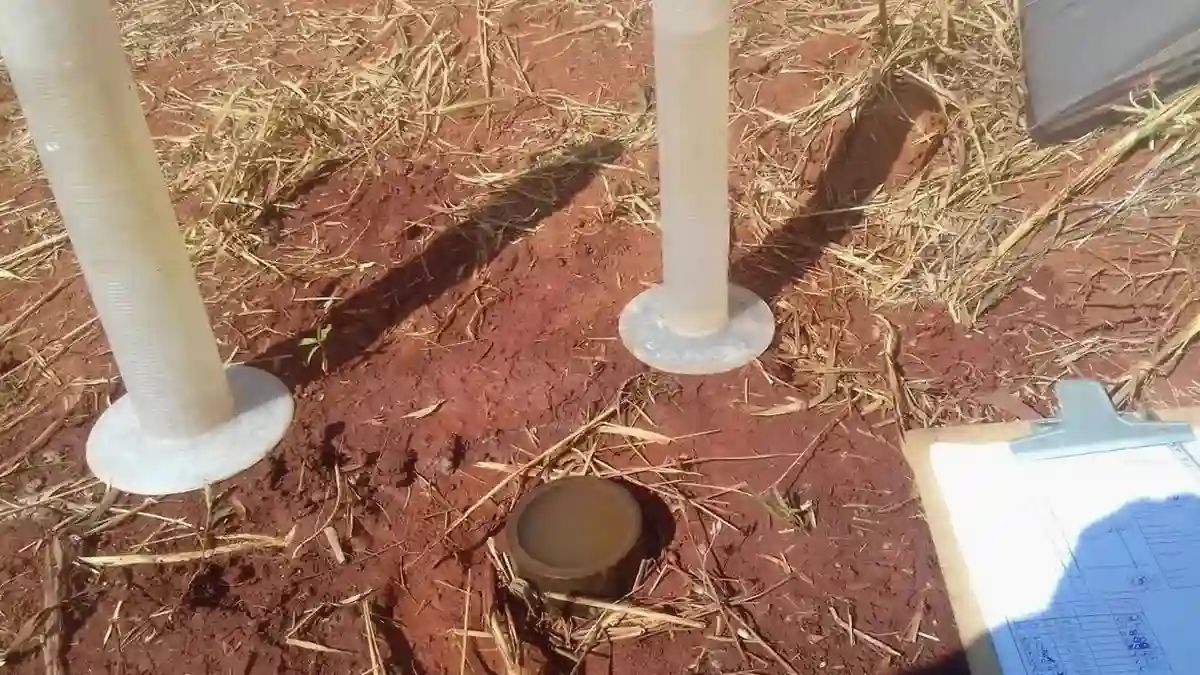
We install a slotted screen with a clean sand filter at the target depth, measure the static water level, and run a falling-head sequence timed with a pressure transducer. The k-value is calculated using the Hvorslev shape factor for the screen geometry, and we report the result alongside the soil description from the same borehole.
Lugeon packer test in rock
For Oxford's limestone and mudstone, we use a pneumatic double packer to isolate a test interval — normally 3 m to 5 m — and apply up to five pressure stages. The flow rate is measured at each pressure, and the Lugeon coefficient is calculated. We deliver the full pressure-versus-flow curve so you can identify turbulent flow, wash-out, or fracture dilation behaviour.
Quick answers
What is the cost of a field permeability test in Oxford?
For an individual Lefranc test in a soil borehole or a single Lugeon test interval in rock, our fee generally falls between £460 and £890, depending on depth, access conditions, and whether the borehole is already available or needs to be advanced first. A site with multiple test intervals or combined soil-and-rock profiling will be quoted based on the number of intervals and the rig time required.
When is a Lugeon test required instead of a Lefranc test?
The Lugeon test is the standard method when the ground is rock — limestone, mudstone, or sandstone — where you need to measure the hydraulic conductivity of the rock mass, including fractures and fissures. The Lefranc method is applied in soil or very soft, weathered material where a packer cannot seal. On Oxford sites where the geology transitions from gravel into the mudstone and then into the Corallian limestone, we often run both tests in the same borehole, just at different depths.
How long does an in-situ permeability test take on site?
A single Lefranc falling-head test typically takes 30 to 60 minutes of monitoring once the water level has stabilised, plus the time to install the screen and sand filter. A Lugeon test with five pressure steps over a 3 m interval usually runs for about 1 to 1.5 hours. The critical factor is letting the water level recover to static between tests, especially in Oxford's low-permeability clays, where recovery can take several hours. We plan the test schedule around this so you are not paying a rig to stand idle. More info.