Oxford's geology presents a particular challenge for underground construction: the river terrace gravels of the Thames and Cherwell valleys sit atop a complex sequence of Oxford Clay, a notoriously weak, overconsolidated material that swells and shrinks with moisture change. Any tunnel alignment passing beneath the historic city core, from Jericho to Grandpont, encounters this soft Jurassic formation at depths as shallow as 8 metres. The groundwater table across the floodplain sits barely 2 metres below the surface in winter, meaning TBMs and sequential excavation methods both require continuous dewatering and face support. A desk study alone will not cut it here. The cpt-test campaign provides a continuous profile of undrained shear strength, helping define stand-up time before shotcrete lining, while the atterberg-limits characterise the plasticity range that governs long-term creep behaviour in the Oxford Clay.
Oxford Clay can lose 60% of its undisturbed strength within hours of exposure. Understanding that decay curve before the TBM arrives is what separates a controlled drive from a surface collapse.
Methodology applied in Oxford
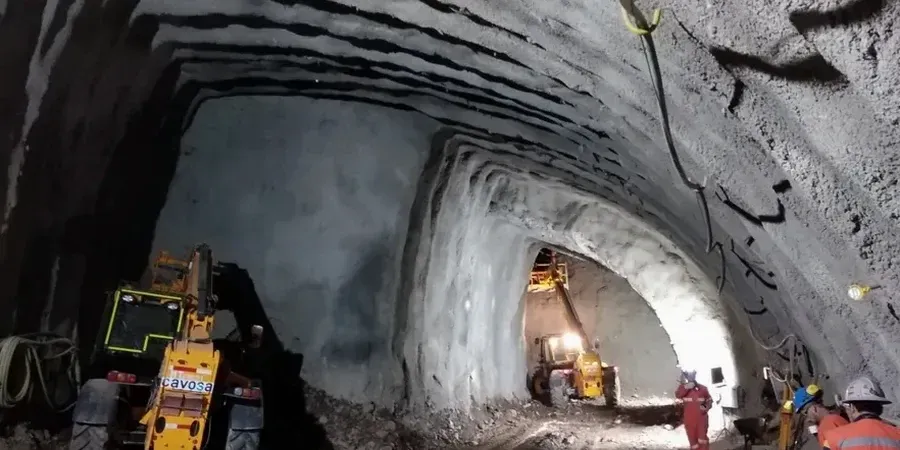
Local geotechnical conditions in Oxford
The risk profile changes sharply between the Headington hill slopes and the Botley Road floodplain. Up on the Corallian limestone ridges, tunnelling is a rock mechanics problem with occasional karstic voids. Down in the city centre near Folly Bridge, the saturated alluvium and softened upper Oxford Clay create face instability risks that have stopped TBMs before. The borehole logs from the Westgate redevelopment showed a 3-metre band of completely weathered clay directly beneath the gravels, a zone with the consistency of toothpaste that requires forepoling or ground freezing in open-face excavations. Ignoring the lateral variability across just 500 metres of alignment can result in catastrophic overbreak, settlement damage to grade-I listed college buildings, and months of contractual delay. The grouting programme ahead of the cutterhead, designed from the permeability profile, becomes the single most important mitigation measure in these mixed-face conditions.
Our services
The focus is on delivering actionable geotechnical parameters for tunnel design under Oxford's specific constraints. Each investigation package is scoped after a walkover survey of the alignment and a review of British Geological Survey borehole records for the relevant 1:10,000 sheet.
Tunnel alignment ground investigation
Rotary cored boreholes with in-situ SPT and CPTu soundings along the proposed tunnel corridor. Includes sampling for laboratory classification, strength, and consolidation testing in accordance with BS 5930. We deliver a Ground Investigation Report with interpreted geotechnical cross-sections and design parameters for TBM or SEM tunnelling.
Settlement and building damage assessment
Assessment of ground movement predictions using analytical (Gaussian trough) and numerical methods calibrated to local stiffness data. Stage-2 and Stage-3 damage classification per Burland methodology for all structures within the zone of influence, essential for party wall negotiations and college bursar approvals in central Oxford.
Quick answers
How long does a soft soil tunnel investigation take for a typical Oxford city centre project?
A focused investigation with 4 to 6 boreholes and CPT soundings along a 500-metre alignment usually takes 4 to 6 weeks on site, plus another 4 to 5 weeks for laboratory testing and reporting. Access constraints in college quads or narrow lanes can extend the programme, so we always factor in a week of contingency for logistics.
What is the typical cost range for a geotechnical investigation for tunnelling in Oxford's soft soils?
For a preliminary design-stage investigation covering a short tunnel section, budgets typically fall between £2.900 and £14.230 depending on borehole depth, number of CPTs, and the laboratory testing schedule. A full detailed-design campaign with triaxial testing on multiple horizons will sit at the upper end of that range.
Can you drill boreholes inside restricted areas like college gardens or listed courtyards?
Yes. We use compact windowless sampling rigs and lightweight CPT crawlers that exert ground pressures below 40 kPa, suitable for sensitive surfaces. All work is planned with the university estates team and the Oxford City conservation officer, and we deliver method statements covering vibration limits and reinstatement of paving or lawns.
Which laboratory tests are most important for Oxford Clay when designing a tunnel?
Consolidated-undrained triaxial tests with pore pressure measurement are the backbone, giving effective stress parameters for stability analysis. We also run oedometer consolidation tests to determine the compression index and swelling pressure, and Atterberg limits to classify the plasticity range. For the river gravels, particle size distribution and permeability tests are standard.